
Best Insulated Work Boots for Cold Weather & Winter Work (2026 Guide)
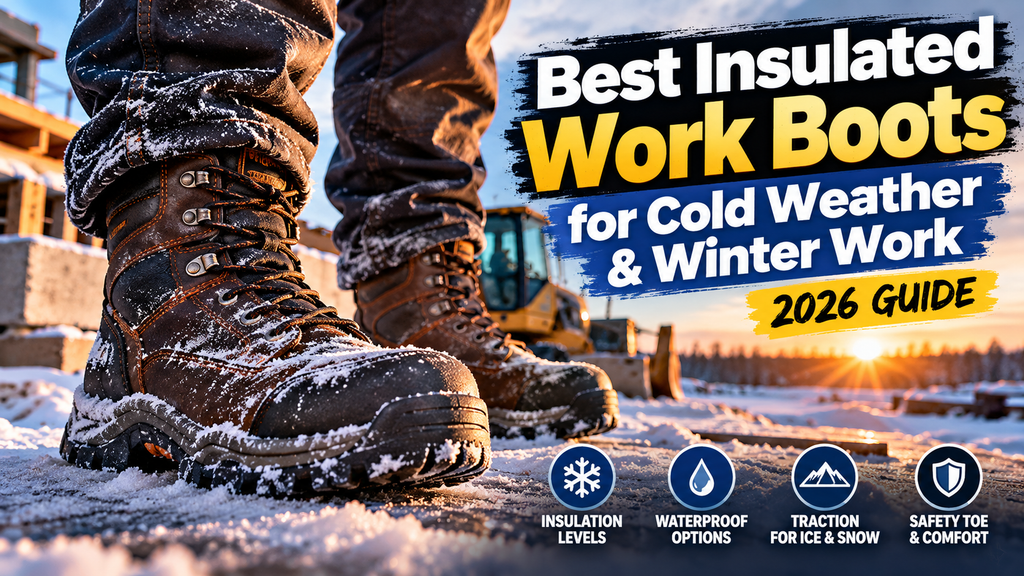
Cold weather changes what you need from a work boot. A boot that feels perfect in October can become miserable once you are standing on frozen ground, walking through slush, working on a loading dock, clearing snow, or spending hours outside in January.
The best insulated work boots are not simply the warmest boots you can find. They need the right amount of insulation for how active you are, waterproofing that matches the conditions, enough room for proper socks, traction for winter surfaces, and the safety protection your job actually requires.
This guide focuses on practical cold-weather work boots for people who still have a job to do when the temperature drops. We compared current insulated models from Timberland PRO, Thorogood, KEEN Utility, Carhartt, Wolverine, and Danner, with options ranging from lighter 200-gram insulation to warmer 600-gram boots.
Disclosure: As an Amazon Associate, HardWorkerGear may earn from qualifying purchases. This does not change the price you pay. We focus on matching the boot to the job, conditions, and worker rather than simply recommending the warmest or most expensive option.
👉 Quick Tip: Insulation weight is not a temperature rating. A 600g boot is not automatically “better” than a 200g boot. How much warmth you need depends on activity level, wind, moisture, sock choice, fit, and how long you are exposed to the cold.
Quick Comparison: Best Insulated Work Boots for Winter
| Recommendation / Product | Best For | Why It Makes Sense |
|---|---|---|
| Best Overall Timberland PRO Boondock 8″ Composite Toe Waterproof Work Boot | Cold outdoor jobs where warmth, waterproofing, and safety protection all matter | 600g insulation, composite safety toe, waterproof construction, and an aggressive all-weather outsole make it the strongest all-around winter pick. |
| Best Heavy-Duty 400g Boot Thorogood Jobsite Series 8″ 804-4244 | Workers who want a welted leather boot with winter protection | 400g Thinsulate, waterproofing, composite safety toe, and Goodyear storm welt construction give it a traditional heavy-duty work-boot build. |
| Best Lightweight Safety Toe KEEN Utility Evanston 6″ 400g Carbon Toe | Active workers who want warmth without a bulky steel-toe feel | 400g insulation, a non-metallic carbon safety toe, and KEEN.ReGEN cushioning make it a strong choice for workers who cover ground. |
| Best Flexible 8″ Boot Carhartt Rugged Flex Waterproof Insulated Composite Toe | Construction, maintenance, and mixed indoor/outdoor winter work | 400g Thinsulate, waterproofing, composite toe protection, and a flexible midsole balance winter protection with movement. |
| Best for Active Work / Moderate Cold Wolverine I-90 DuraShocks Waterproof Insulated 8″ | Workers who stay moving and do not need maximum insulation | 200g Thinsulate provides lighter warmth while DuraShocks cushioning and waterproof construction focus on long-day comfort. |
| Best Plain-Toe Winter Work Boot Danner Caliper 400G 8″ | Workers who do not need a safety toe but still need serious cold-weather jobsite performance | 400g Thinsulate, waterproof Danner Dry protection, oil/slip resistance, and a plain-toe design make it a strong premium option. |
Quick Take: For colder outdoor work, the Timberland PRO Boondock is the strongest all-around pick. For most general winter jobs, 400g models like the Thorogood Jobsite, KEEN Evanston, and Carhartt Rugged Flex hit a useful middle ground. If you stay active and tend to overheat, the 200g Wolverine I-90 may make more sense. If your job does not require a safety toe, the Danner Caliper gives you a warmer plain-toe option.
How Much Insulation Do You Actually Need?
Insulation is one of the easiest specifications to compare and one of the easiest to misunderstand.
You will often see work boots advertised with 200g, 400g, 600g, or even more insulation. Those numbers describe the amount of insulation material used in the boot. They do not translate directly into a guaranteed temperature rating.
| Insulation Level | Usually Makes Sense For | Main Trade-Off |
|---|---|---|
| 200g | Active workers, cool-to-cold conditions, frequent walking, mixed indoor/outdoor work | May not be enough for long periods standing still in deeper cold |
| 400g | General winter work, snow, outdoor maintenance, construction, loading docks | Can feel warm indoors or during very high activity |
| 600g+ | Colder outdoor jobs, slower-paced work, longer exposure, workers who naturally run cold | More bulk and a greater chance of overheating if you are constantly moving |
If you are walking all day, climbing ladders, carrying material, or moving between indoor and outdoor areas, too much insulation can become uncomfortable. Sweat inside a winter boot is not your friend. Once your socks get damp, your feet can feel colder when activity slows down.
On the other hand, someone standing in one place on frozen ground or working outside for long stretches may appreciate the extra insulation of a heavier boot.
🤔 Something to Think About: Your work pace matters almost as much as the weather. The person walking ten miles around a yard may need less insulation than the person standing at a gate, lift, machine, or outdoor station for hours.
What Matters Most in a Winter Work Boot
Waterproofing
Cold and wet is much harder to manage than cold and dry. Snow melts. Slush gets deep around curbs and loading areas. Mud and puddles appear when temperatures swing above freezing.
If you routinely work around snow, slush, wet pavement, or muddy winter jobsites, waterproof construction should be near the top of your list.
Traction
A winter boot still needs to grip the surfaces you actually work on. Aggressive lugs help on snow, mud, and loose ground, while a boot used mostly on concrete or shop floors also needs predictable slip resistance.
No work boot makes ice harmless. If your job puts you on significant ice, your employer may require additional traction equipment or a specific winter-safety procedure.
Safety Toe Type
Start with the protection your workplace requires. Do not choose a soft-toe boot because it feels warmer or lighter if your job requires a rated safety toe.
Composite and carbon safety toes are popular in cold-weather work because they provide non-metallic protection and can reduce weight compared with some traditional steel-toe boots. The important thing is still the safety standard, fit, and the requirements of your job.
Fit With Winter Socks
Insulated boots need room to work. If you cram your foot into a boot with thick socks and compress everything tightly, comfort and warmth can suffer.
Try winter work boots with the type of socks you actually plan to wear. Your toes should have room to move without your heel swimming inside the boot.
⚠️ Common Mistake: Do not automatically size up a full size just because the boot is insulated. Start with the manufacturer’s sizing guidance and try the boot with your winter socks. Oversized boots can create heel slip and blisters, while undersized boots can crowd your toes.
Best Overall: Timberland PRO Boondock 8″ Composite Toe Waterproof Work Boot
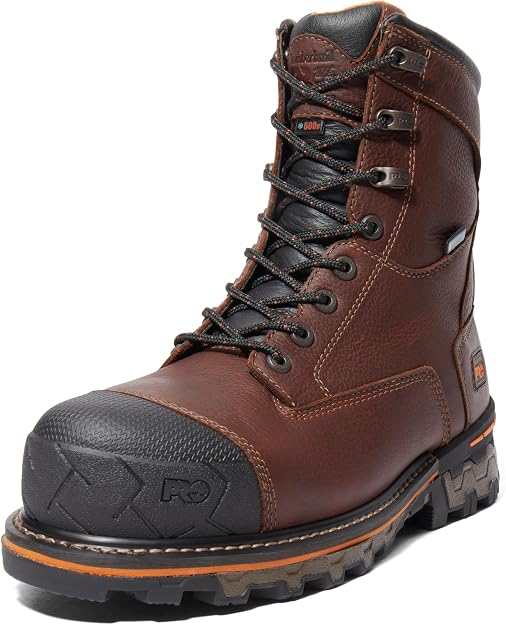
Best Overall: Timberland PRO Boondock 8″ Composite Toe Waterproof Work Boot
Best for: Cold outdoor jobs where warmth, waterproofing, durability, and safety protection all matter.
Why it makes sense: Timberland combines 600g insulation with a composite safety toe, waterproof leather/membrane construction, anti-fatigue cushioning, and an all-weather TPU outsole built for demanding environments.
The Timberland PRO Boondock 8-inch is the best overall pick because it is the most complete cold-weather safety boot in this group.
Timberland uses 600 grams of insulation, making this the warmest boot in our main lineup. It also includes a composite safety toe, waterproof leather with an internal waterproof membrane, a molded rubber toe protector, external heel support, Anti-Fatigue Technology underfoot, and an all-weather TPU outsole designed for traction in harsh conditions.
This is the boot to look at when winter is not just something you walk through between the truck and the building. If you spend meaningful time outdoors, work in snow, deal with wet winter ground, or spend portions of the day standing rather than constantly moving, the extra insulation makes sense.
Choose It If
You need a genuinely winter-oriented safety boot and are willing to accept additional bulk for more insulation and protection.
Skip It If
You spend most of your shift indoors, walk constantly, or tend to overheat in insulated footwear. A 600g boot can be more warmth than some workers need.
Pros
- 600g insulation for colder conditions
- Composite safety toe
- Waterproof construction
- Anti-fatigue cushioning
- Rubber toe protection
- All-weather outsole
Cons
- Heavier and bulkier than lighter insulated boots
- Can be too warm for high-activity or mostly-indoor shifts
- Premium price range
Trade-off: You are buying more winter protection, but you are also committing to a warmer, more substantial boot.
Best Heavy-Duty 400g Boot: Thorogood Jobsite Series 8″ 804-4244
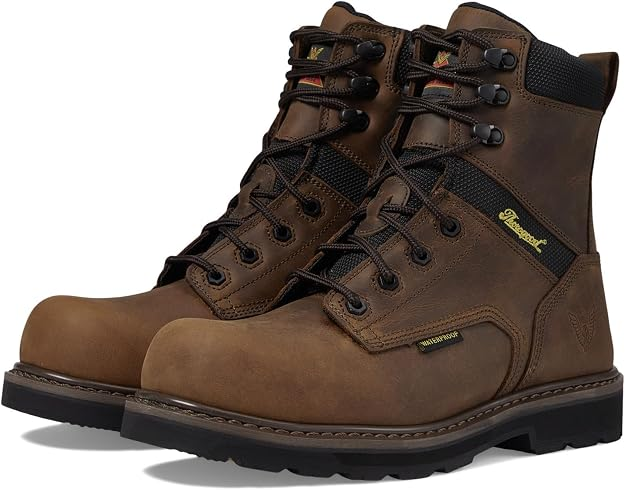
Best Heavy-Duty 400g Boot: Thorogood Jobsite Series 8″ 804-4244
Best for: Workers who want a traditional leather work-boot build with a useful middle level of winter insulation.
Why it makes sense: It combines 400g 3M Thinsulate, waterproofing, a composite safety toe and shank, oil/slip resistance, and Goodyear storm welt construction.
The Thorogood Jobsite Series sits in a good middle ground for workers who want a serious work boot without jumping all the way to 600g insulation.
Thorogood lists 400g 3M Thinsulate insulation, waterproof construction, a composite safety toe, composite shank, rubber/EVA outsole, electrical-hazard protection, and oil/slip resistance. The Goodyear storm welt construction also gives it a more traditional heavy-duty work-boot feel than some lighter athletic-inspired options.
Choose It If
You want a rugged 8-inch winter safety boot for construction, maintenance, outdoor trades, or jobs where leather and welted construction appeal to you.
Skip It If
You want the lightest boot possible or prefer a more athletic work-boot feel.
Pros
- 400g 3M Thinsulate
- Waterproof
- Composite safety toe and shank
- Goodyear storm welt construction
- Oil- and slip-resistant design
- 8-inch height for more coverage
Cons
- Traditional construction can feel more substantial than athletic-style boots
- 400g insulation may be excessive for mostly indoor work
- Not the pick for workers who prioritize low weight above everything else
Trade-off: It gives you a rugged, traditional work-boot structure, but that is not the same experience as a lighter flexible boot.
Best Lightweight Safety Toe: KEEN Utility Evanston 6″ Insulated Waterproof Carbon Toe
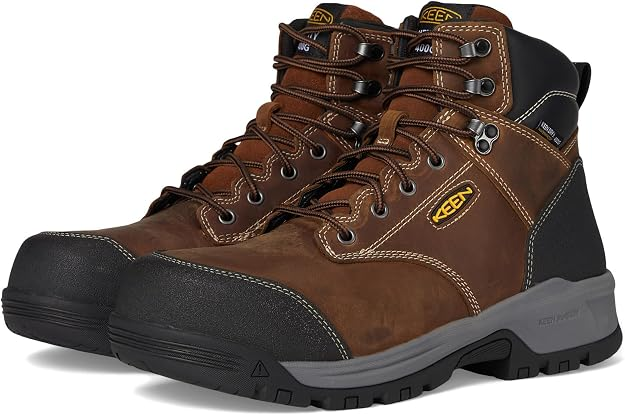
Best Lightweight Safety Toe: KEEN Utility Evanston 6″ Insulated Waterproof Carbon Toe
Best for: Active workers who need winter warmth and safety protection but dislike a heavy steel-toe feel.
Why it makes sense: KEEN pairs 400g insulation with an asymmetrical non-metallic carbon safety toe and energy-returning KEEN.ReGEN cushioning.
The KEEN Utility Evanston is the pick for workers who want winter protection without turning every step into work of its own.
KEEN uses 400g lightweight synthetic insulation and left/right asymmetrical carbon safety toes. The brand says those carbon toes save weight compared with steel, while its KEEN.ReGEN midsole is designed to return energy with each step.
That combination makes the Evanston especially interesting for workers who are active all shift: walking large jobsites, working in yards, moving between buildings, doing deliveries, or spending the day climbing in and out of equipment.
Choose It If
You want 400g-level winter warmth with a lighter non-metallic safety toe and a more mobile feel.
Skip It If
You specifically want an 8-inch boot for more ankle coverage or prefer a traditional heavy leather work boot.
Pros
- 400g insulation
- Non-metallic carbon safety toe
- Waterproof design
- KEEN.ReGEN cushioning
- More athletic feel than some traditional winter boots
Cons
- 6-inch height provides less coverage than taller 8-inch boots
- Workers who prefer a firm traditional boot may not want the more athletic feel
- 400g can still be too warm for heated indoor environments
Trade-off: The Evanston leans toward mobility and lower weight rather than maximum insulation or old-school boot heft.
Best Flexible 8″ Boot: Carhartt Rugged Flex Waterproof Insulated Composite Toe
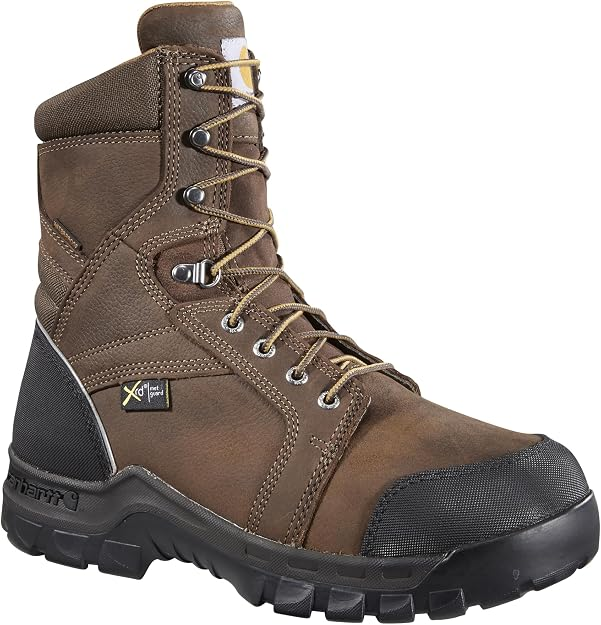
Best Flexible 8″ Boot: Carhartt Rugged Flex Waterproof Insulated Composite Toe
Best for: Mixed indoor/outdoor winter work where you want 8-inch coverage without giving up too much flexibility.
Why it makes sense: It uses 400g 3M Thinsulate, Storm Defender waterproofing, FastDry moisture-wicking lining, a composite toe, and a flexible EVA midsole.
The Carhartt Rugged Flex makes sense for workers whose day does not happen in one environment.
You might be in a heated building for part of the day, outside around equipment later, walking a snowy lot, working from a truck, and then back inside again. Carhartt uses 400g 3M Thinsulate with its Storm Defender waterproof membrane, FastDry lining, composite safety toe, EVA midsole, and a slip-resistant lug outsole.
That combination puts it in the middle of the winter-work spectrum: warmer and more protective than an uninsulated boot, but not as heavily insulated as the 600g Timberland.
Choose It If
You want a versatile 8-inch safety boot for construction, maintenance, utility, warehouse-yard, or mixed-condition work.
Skip It If
You need maximum deep-cold insulation or spend almost your entire shift indoors.
Pros
- 400g 3M Thinsulate
- Waterproof breathable membrane
- Composite safety toe
- Moisture-wicking lining
- Flexible EVA midsole
- Slip-resistant lug outsole
Cons
- Not as warm as a 600g boot for colder stationary work
- More boot than many indoor workers need
- 8-inch construction adds weight compared with shorter options
Trade-off: This is the versatile middle-ground choice rather than the warmest or lightest boot in the guide.
Best for Active Work / Moderate Cold: Wolverine I-90 DuraShocks Waterproof Insulated 8″
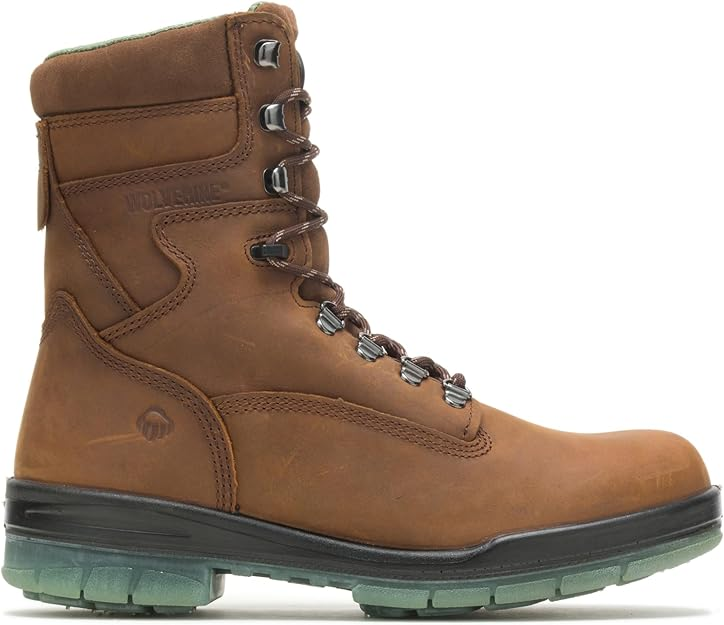
Best for Active Work / Moderate Cold: Wolverine I-90 DuraShocks Waterproof Insulated 8″
Best for: Workers who stay moving and want lighter insulation rather than maximum warmth.
Why it makes sense: Wolverine uses 200g 3M Thinsulate with waterproof direct-attach construction, sweat-wicking lining, and DuraShocks cushioning.
The Wolverine I-90 is the reminder that winter work boots do not all need 400g or 600g insulation.
Wolverine lists 200g 3M Thinsulate in this 8-inch waterproof boot. It also uses permanent direct-attach construction to seal out water, Dri-lex moisture-wicking lining, a removable dual-density footbed, lightweight polyurethane midsole, fiberglass shank, and DuraShocks cushioning.
This can be the smarter choice for workers who generate a lot of body heat because they are walking, lifting, climbing, loading, or moving most of the shift. Lighter insulation can also make more sense when the day involves repeated transitions between outdoors and heated spaces.
🦺 Safety First: The I-90 family is offered in different toe configurations. Make sure the exact version you buy meets your workplace safety requirements. Do not assume every boot with the same family name has the same toe protection or safety rating.
Choose It If
You work actively in cool-to-cold weather and regularly find heavily insulated boots too hot or bulky.
Skip It If
You stand outside for long periods in severe cold or routinely need maximum warmth.
Pros
- 200g insulation for lighter winter warmth
- Waterproof direct-attach construction
- DuraShocks cushioning
- Moisture-wicking lining
- 8-inch height
- Good fit for high-activity winter work
Cons
- Not the warmest option for deep cold
- Exact safety protection depends on the version selected
- Workers who stay stationary may want more insulation
Trade-off: Less insulation improves versatility for active workers, but it also gives you less reserve warmth when activity stops.
Best Plain-Toe Winter Work Boot: Danner Caliper 400G 8″
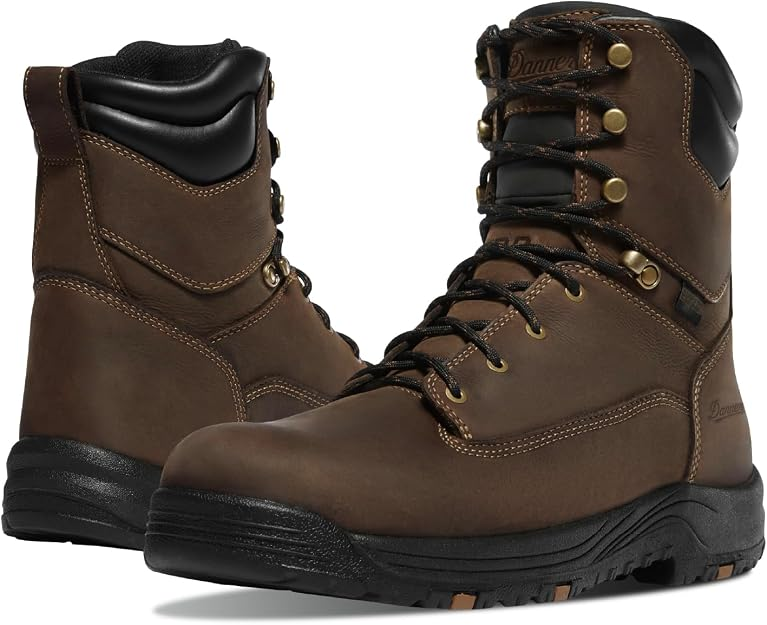
Best Plain-Toe Winter Work Boot: Danner Caliper 400G 8″
Best for: Workers who do not need a safety toe but want a serious waterproof insulated boot for long winter workdays.
Why it makes sense: The Caliper combines 400g Thinsulate Ultra, Danner Dry waterproofing, a plain toe, four-layer underfoot cushioning, and an oil/slip-resistant outsole.
Not every winter job requires a safety toe. If yours does not, there is no reason to automatically accept the extra structure of a safety boot.
The Danner Caliper 400G is an 8-inch plain-toe work boot built specifically for cold-weather work. Danner uses 400g Thinsulate Ultra insulation, its waterproof Danner Dry liner, a fiberglass shank, oil/slip-resistant outsole, and a layered cushioning system intended for long shifts.
This is a particularly strong fit for outdoor maintenance, road crews, machine-shop workers who move outside, property work, equipment operators, and other jobs where winter performance matters but a protective safety toe is not required.
Choose It If
You want a premium plain-toe boot with substantial winter features and do not need impact/compression toe protection.
Skip It If
Your workplace requires a safety toe. The Caliper 400G model in this guide is plain toe.
Pros
- 400g Thinsulate Ultra
- Waterproof Danner Dry liner
- Plain toe for jobs that do not require safety protection
- Oil- and slip-resistant outsole
- 8-inch height
- Comfort-focused underfoot construction
Cons
- No safety toe
- Premium price
- Not necessary for workers who spend winter primarily indoors
Trade-off: You get a winter-focused premium work boot without a safety toe, which makes it completely wrong for some jobs and exactly right for others.
200g vs. 400g vs. 600g: Which Would We Choose?
If you are unsure where to start, think about your normal shift rather than the coldest temperature you might experience once all winter.
- Choose around 200g if you stay active, walk most of the day, move between indoor and outdoor environments, or tend to run warm.
- Choose around 400g if you do general outdoor winter work, construction, maintenance, snow cleanup, yard work, or spend meaningful time outside without being completely stationary.
- Consider 600g or more if you work in colder conditions for long stretches, spend more time standing than walking, or consistently find lighter insulated boots too cold.
Those are starting points, not temperature guarantees. Two workers can wear the same boot in the same weather and have completely different experiences.
Winter Socks Matter More Than People Think
A good insulated boot can still perform badly with the wrong sock.
Look for work socks that manage moisture, fit without bunching, and match the volume inside the boot. Very thick socks are not automatically warmer if they make the boot tight enough to compress your foot.
If you work long winter shifts, carrying a dry spare pair of socks can be more useful than stacking two heavy pairs on top of each other.
💰 Worth the Money? Spend first on the right boot and fit, then on good socks. Expensive insulation cannot compensate for a boot that leaks, slips, pinches your toes, or does not meet your job’s safety requirements.
Common Winter Work Boot Mistakes
- Buying the warmest boot available: More insulation can create sweat and bulk if your work is highly active.
- Ignoring waterproofing: Wet insulation and wet socks can ruin an otherwise good cold-weather setup.
- Buying around one extreme-weather day: Choose for the conditions you work in most often.
- Wearing oversized boots to fit thick socks: Heel slip can create rubbing and blisters.
- Assuming “slip resistant” means ice proof: Ice can overwhelm normal boot traction.
- Ignoring required safety ratings: Winter warmth does not replace toe, electrical, puncture, or other required protection.
- Keeping wet boots in a cold vehicle overnight: Give boots time to dry between shifts whenever possible.
What Could Go Wrong?
The biggest winter-boot problems usually come from choosing around one specification instead of the whole job.
A 600g boot may keep you warm outside but make your feet sweat during an indoor portion of the shift. A light 200g boot may feel great while you are moving but leave your feet cold when you spend an hour standing still. A waterproof boot may keep slush out but feel warmer and less breathable than you prefer. A soft-toe boot may be comfortable but unusable at a workplace that requires safety toes.
That is why the best winter boot is not the one with the biggest insulation number. It is the one that matches the cold, moisture, movement, surfaces, and hazards you actually deal with.
🦺 Safety First: Cold-weather footwear does not eliminate winter hazards. Use additional traction devices when required, follow your workplace’s ice/snow procedures, and never replace required safety footwear with a warmer boot that does not meet the job standard.
How to Make Your Final Decision
Start with five questions:
- How much of my shift is actually outside?
- Am I walking constantly or standing in one place?
- Do I regularly work in snow, slush, or wet conditions?
- What safety-toe or other footwear standards does my job require?
- Do I normally run hot or cold in winter footwear?
If you want the strongest all-around cold-weather safety boot, start with the Timberland PRO Boondock 8".
If you want a traditional heavy-duty 400g boot, choose the Thorogood Jobsite Series 8".
If you walk a lot and want a lighter non-metallic safety toe, look at the KEEN Utility Evanston.
If your day mixes indoor and outdoor work and you want a versatile 8-inch safety boot, the Carhartt Rugged Flex makes sense.
If you stay active and do not need heavy insulation, the Wolverine I-90 DuraShocks 200g is the lighter-warmth option.
If your job does not require a safety toe, the Danner Caliper 400G is our plain-toe pick.
Frequently Asked Questions
Is 400g insulation enough for winter work boots?
For many workers, 400g is a useful middle ground for general winter work. Whether it is enough depends on the temperature, your activity level, how long you are outside, wind and moisture, your socks, and how warm or cold your feet normally run.
Is 600g insulation too much for work boots?
It can be. Workers who walk constantly or move frequently between heated buildings and outdoor areas may find 600g boots too warm. Workers standing outside for longer periods in colder conditions may appreciate the extra insulation.
Are composite toe boots better for winter?
Composite and other non-metallic safety toes are popular for winter work because they can reduce weight and avoid having a metal toe cap. But “better” depends on the job. Use the toe protection required by your workplace and make sure the exact boot meets the necessary safety standard.
Should winter work boots fit loose?
They should have enough room for your intended socks and toe movement without allowing excessive heel slip. Do not intentionally buy a sloppy fit just to make room for thick socks.
Do waterproof work boots make your feet sweat more?
Waterproof membranes can reduce airflow compared with some non-waterproof boots, and insulated boots are already warmer. Moisture-wicking socks and choosing the right insulation level for your activity can help manage that trade-off.
What is better for snow: a 6-inch or 8-inch work boot?
An 8-inch boot gives you more coverage around the ankle and can help when working around deeper snow, slush, and uneven winter ground. A 6-inch boot can feel lighter and more flexible for workers who stay active or deal mostly with cleared surfaces.
Related HardWorkerGear Guides
Keep building your cold-weather work setup:
- Best Work Boots for Standing on Concrete All Day
- Best Boots for Snow Shoveling (2026 Guide)
- Best Winter Work Gloves
- Essential Gear for Outdoor Work
Why You Can Trust HardWorkerGear
HardWorkerGear focuses on practical gear decisions for people who work long shifts, spend time outside, move between real jobsite conditions, and need equipment that matches the work instead of just looking good on a product page.
For this guide, we compared current manufacturer specifications including insulation level, waterproofing, toe protection, boot height, outsole design, cushioning, and intended use. We have not claimed hands-on testing of these six boots. The goal is to explain the trade-offs clearly enough that you can narrow the list based on your job and winter conditions.
Final Thoughts
Winter work boots are a balancing act. Warmth matters, but so do moisture control, traction, weight, fit, safety protection, and how much you move during the day.
For serious cold-weather safety work, the Timberland PRO Boondock 8" is our best overall choice because its 600g insulation, waterproofing, composite toe, and winter-oriented outsole give it the most complete cold-weather package.
For most general winter jobs, the 400g class is probably the more versatile place to shop. The Thorogood Jobsite, KEEN Evanston, and Carhartt Rugged Flex each approach that middle ground differently. The Wolverine I-90 makes sense when activity and comfort matter more than maximum insulation, while the Danner Caliper 400G gives plain-toe workers a strong cold-weather option.
Start with your job requirements. Then choose the insulation level that matches the work you actually do—not just the coldest number on the weather app.