
Beginner 3D Printing Supplies Checklist: Filament, Tools, Storage, and Safety
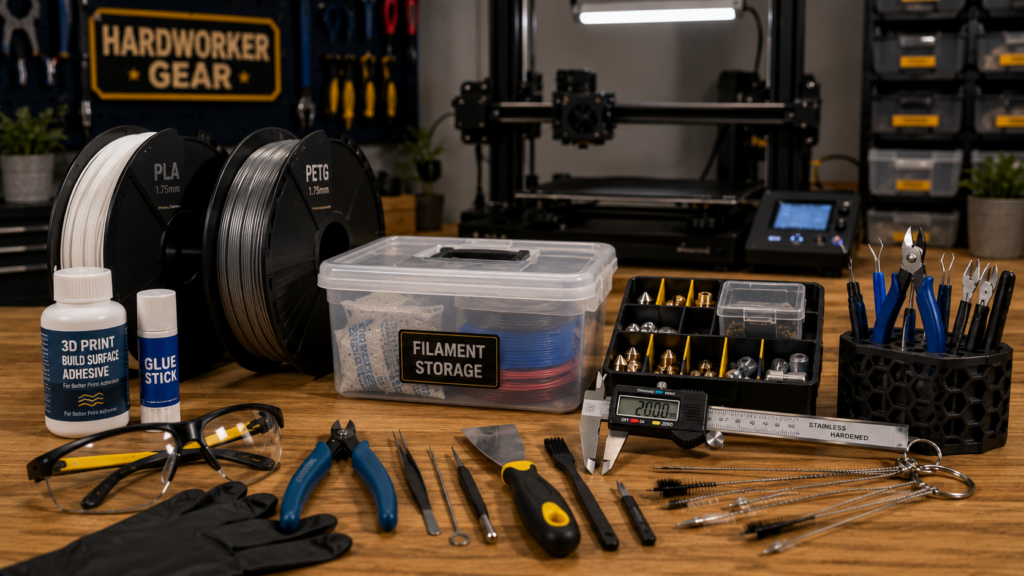
Buying a beginner 3D printer is only the first step.
Once the printer shows up, you quickly realize there are a few other things that make 3D printing easier, cleaner, safer, and less frustrating.
You need filament. You need a few basic tools. You need a way to store supplies. You need to measure parts if you want practical prints to fit. You need to think about safety, cleanup, and where all the small printer accessories are going to live.
The trick is not buying everything at once.
A lot of beginners overbuy accessories before they even understand what they need. Others buy only the printer and one roll of filament, then get stuck because they do not have the right basic tools to remove prints, trim edges, measure parts, or keep supplies organized.
This beginner 3D printing supplies checklist is built for students, homeowners, garage users, desk setup builders, home workshop people, and anyone trying to make 3D printing practical from the start.
Disclosure: As an Amazon Associate, HardWorkerGear earns from qualifying purchases. This does not change the price you pay. This guide includes supply and accessory recommendations for beginner 3D printing setups.
👉 Quick Tip: Start with supplies that help you print, measure, clean up, store filament, and stay safe. Skip the fancy upgrades until you know what problems you actually have.
Beginner 3D Printing Supplies: What You Actually Need First
A beginner setup does not need to look like a professional print farm.
You do not need every nozzle size, every filament type, every upgrade part, every bed adhesive, and every specialty tool on day one.
What you need first is a practical starter setup:
- PLA filament
- PETG filament later, when you are ready for tougher prints
- Basic 3D printer tool kit
- Digital calipers
- Filament storage
- Flush cutters
- Scraper or print removal tool
- Nozzle cleaning tools
- Small parts organizer
- Safety glasses
- Gloves when working with chemicals, resin, adhesives, or cleanup products
That is enough to get started without turning your first printer into a pile of accessories you do not understand yet.
Quick Checklist: Best Beginner 3D Printing Supplies
| Supply | Best For | Buy Now or Later? |
|---|---|---|
| PLA Filament | First prints, desk organizers, labels, trays, school projects, basic parts | Buy first |
| PETG Filament | Tougher clips, garage parts, light-duty brackets, more durable prints | Buy later or second |
| Basic 3D Printer Tool Kit | Print removal, trimming, finishing, cleaning, maintenance | Buy first |
| Flush Cutters | Cutting filament ends, trimming stringing, and cleaning up supports | Buy first |
| Scraper / Print Removal Tool | Removing prints from the build plate carefully | Buy first |
| Digital Calipers | Measuring parts, checking fit, designing useful prints | Buy early |
| Filament Storage Box or Dry Box | Keeping filament dry, clean, and organized | Buy early |
| Nozzle Kit / Cleaning Kit | Replacing worn nozzles and cleaning small clogs | Buy later |
| Bed Adhesion Supplies | Helping prints stick when needed | Buy only if needed |
| Small Parts Organizer | Nozzles, tools, spare parts, clips, screws, failed test pieces | Buy early |
| Safety Glasses | Trimming, scraping, clipping, and cleanup work | Buy first |
| Nitrile Gloves | Chemicals, adhesives, resin, messy cleanup, and material handling when needed | Buy if needed |
| Printer Station Storage | Keeping printer tools, filament, parts, and supplies in one controlled area | Buy early if space is tight |
Quick Take: Start with PLA filament, a basic tool kit, digital calipers, filament storage, safety glasses, and a small parts organizer. Add PETG, nozzle kits, bed adhesion tools, and specialty supplies after you understand what kind of prints you actually make.
1. PLA Filament
Starter Supply: PLA Filament
Best for: Beginner prints, school projects, desk organizers, labels, trays, light-duty holders, and learning the basics.
Why it makes sense: PLA is usually the easiest starting material for most beginners because it works well for many simple, useful prints.
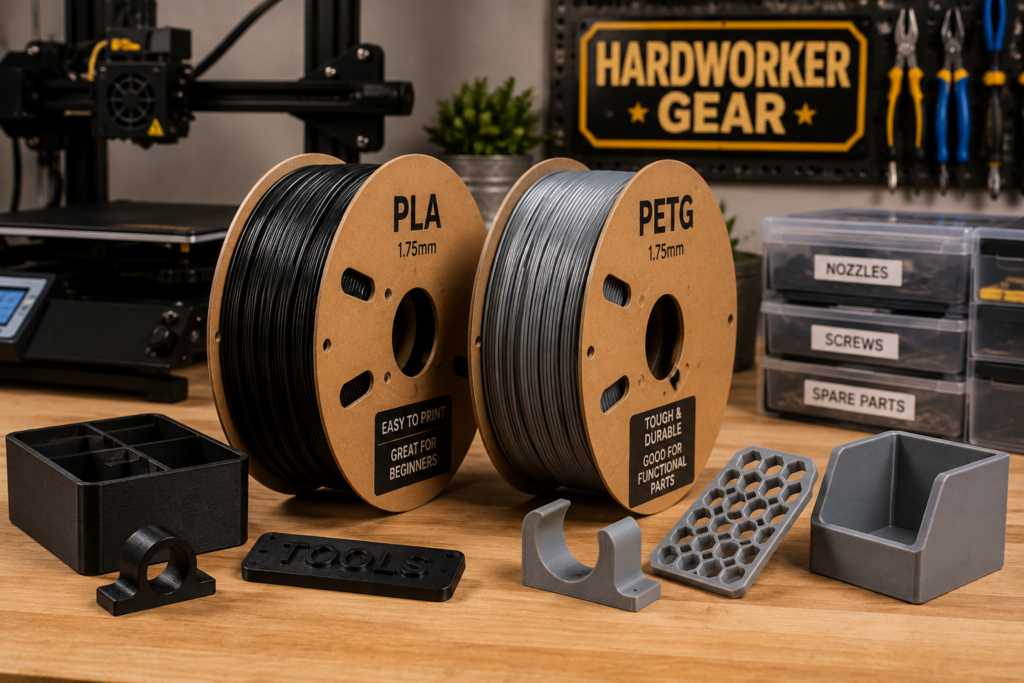
PLA filament should be the first material most beginners buy.
It is a good starting point because it is commonly used, beginner-friendly, and useful for a lot of practical prints. If you are making cable clips, desk organizers, storage labels, small trays, school project parts, or simple tool holders, PLA is often enough to get started.
That does not mean PLA is perfect for every job.
It is not the best choice for high-heat areas, demanding outdoor use, heavy-duty brackets, or parts that need serious impact resistance. But for learning and everyday organization prints, it is the smart place to start.
Good PLA projects
- Desk trays
- Cable clips
- Label holders
- Small parts trays
- Phone stands
- Drawer dividers
- School project parts
- Light-duty organizers
Skip PLA if
You need a part that will live in heat, direct sunlight, outdoor stress, heavy loads, or a demanding garage environment.
2. PETG Filament
Starter Supply: PETG Filament
Best for: Tougher garage parts, clips, light-duty brackets, storage pieces, and prints that need more durability than PLA.
Why it makes sense: PETG can be a useful second filament once you understand the basics of printing with PLA.
PETG filament is a good next step after PLA.
For beginners, PETG is not always the best first material because it may require more tuning and patience. But once you understand your printer, PETG can be useful for tougher parts, light-duty garage pieces, clips, brackets, and prints that need better durability.
For HardWorkerGear readers, PETG makes sense when your prints move from desk organization toward garage and workshop use.
Good PETG projects
- Light-duty brackets
- Garage clips
- Tool tags
- Durable organizers
- Storage bin accessories
- Parts that need more toughness than basic PLA
Skip PETG if
You are still learning basic setup, bed adhesion, slicing, and print troubleshooting. Start with PLA first, then move into PETG when you are ready.
🤔 Something to Think About: Do not buy five filament types before you understand one. PLA first, PETG second is a smarter beginner path than chasing every material at once.
3. Basic 3D Printer Tool Kit
Starter Supply: Basic 3D Printer Tool Kit
Best for: Print removal, cleanup, trimming, finishing, nozzle cleaning, and basic maintenance.
Why it makes sense: A basic tool kit gives beginners the simple cleanup and maintenance tools they need without buying everything separately.
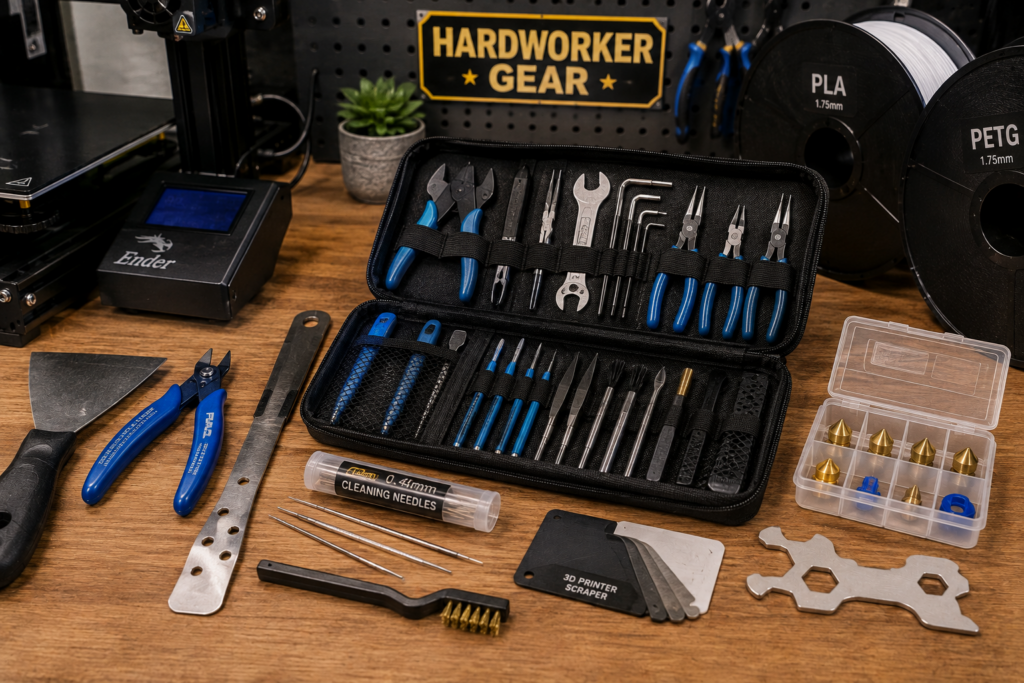
A basic 3D printer tool kit is one of the most useful early purchases.
Many printers include a few starter tools, but they are not always enough for long-term use. A better beginner kit usually gives you the tools you need to remove prints, trim rough edges, clean small areas, and handle basic maintenance.
Useful tools may include:
- Flush cutters
- Scraper or removal tool
- Needle-nose pliers
- Small files
- Nozzle cleaning needles
- Brushes
- Deburring tool
- Utility knife or hobby knife
You do not need to become a professional print technician on day one. But you do need a few basic tools so every print does not turn into a fight.
4. Flush Cutters
Starter Supply: Flush Cutters
Best for: Cutting filament ends, trimming stringing, removing small support pieces, and cleaning up print leftovers.
Why it makes sense: Flush cutters are one of the small tools beginners end up using constantly around a 3D printer.
Flush cutters are one of the most-used small tools in a 3D printing setup.
They are useful for cutting filament ends, trimming stringing, removing small support pieces, and cleaning up minor print leftovers.
This is a simple tool, but it gets used constantly.
Look for a pair that feels comfortable and cuts cleanly. Do not use them for heavy metal wire unless they are rated for it. Most small flush cutters used around 3D printing are meant for plastic and light cleanup work.
5. Scraper or Print Removal Tool
Starter Supply: Scraper / Print Removal Tool
Best for: Carefully removing prints from the build plate without damaging the print or build surface.
Why it makes sense: A scraper or removal tool helps lift finished prints, but it needs to be used slowly and carefully.
A scraper or print removal tool helps lift parts off the build plate.
This can be useful, but it also needs common sense. Scraping too aggressively can damage the build surface or send a sharp edge where you do not want it.
Use the tool carefully, follow your printer and build plate instructions, and avoid forcing prints loose while the bed is still too hot or the part is stuck hard.
⚠️ Common Mistake: Beginners often treat the scraper like a pry bar. Slow down. A damaged build plate can cause more problems than a stuck print.
6. Digital Calipers
Starter Supply: Digital Calipers
Best for: Measuring parts, checking fit, designing custom holders, testing tolerances, and making useful prints work in real spaces.
Why it makes sense: If you want parts to fit, you need to measure. Digital calipers are one of the best tools a practical 3D printer user can own.
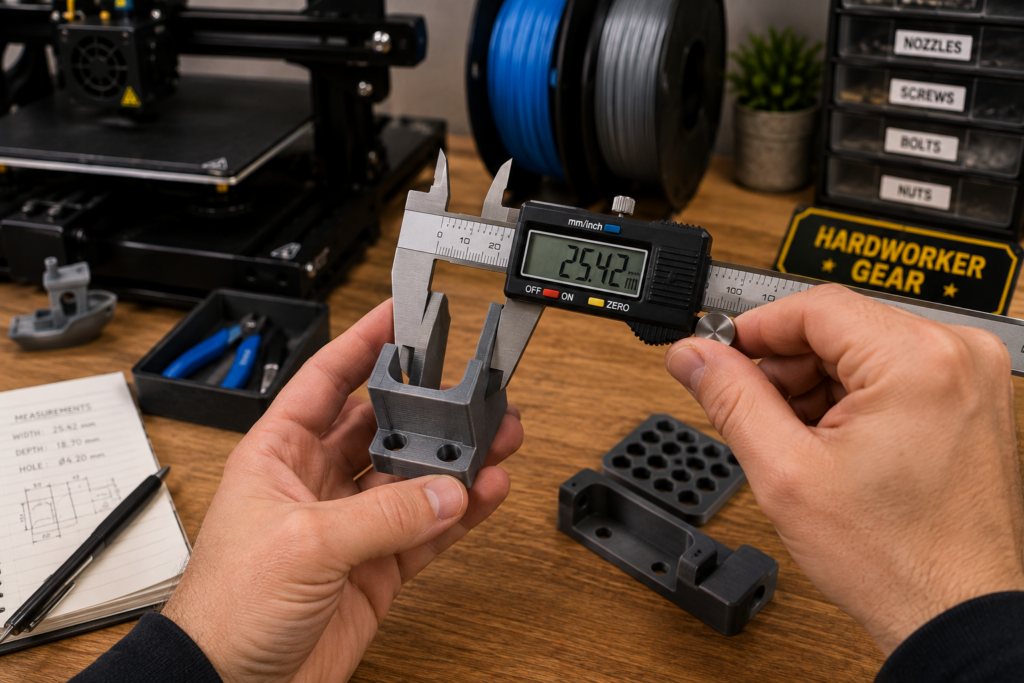
Digital calipers are one of the most important tools for useful 3D printing.
If you only print decorative items, you can get away without measuring much. But if you want to make tool holders, drawer dividers, brackets, clips, spacers, trays, battery holders, or storage parts, measurement matters.
Calipers help you measure:
- Hole sizes
- Slot widths
- Tool handles
- Drawer depth
- Battery dimensions
- Fastener sizes
- Part thickness
- Clearance between pieces
For garage, desk, and workshop prints, calipers are what help move you from “close enough” to “actually fits.”
7. Filament Storage Box or Dry Box
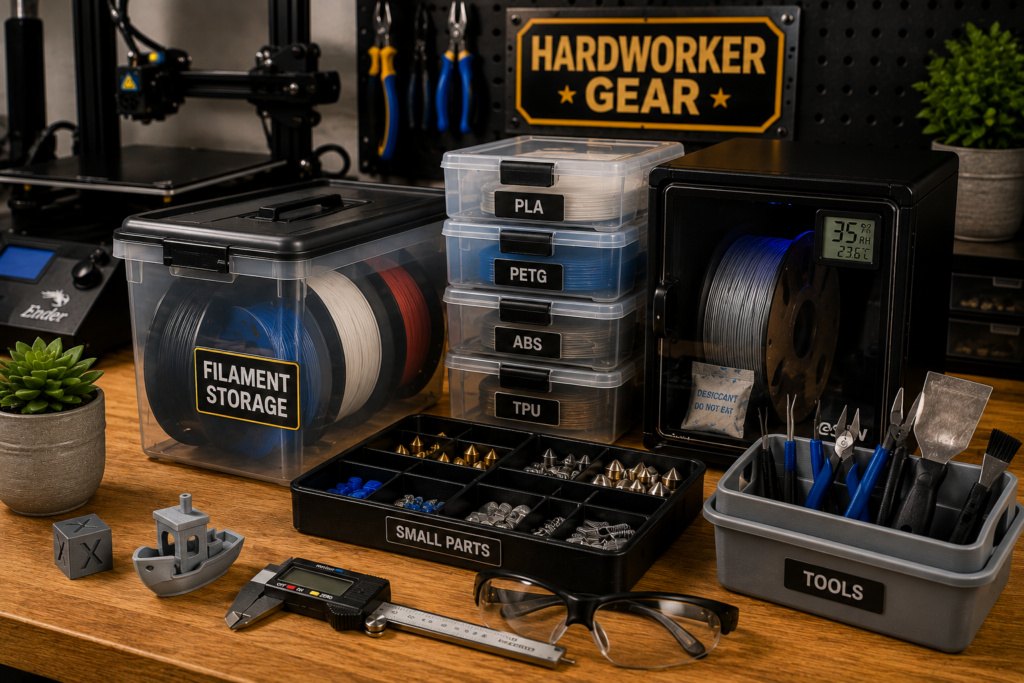
Starter Supply: Filament Storage Box or Dry Box
Best for: Keeping filament dry, clean, organized, and easier to manage.
Why it makes sense: Poor filament storage can cause print problems and clutter. A storage setup helps protect your supplies.
Filament storage is easy to ignore at first.
Then you end up with open spools, tangled ends, dusty filament, half-used rolls, and mystery materials sitting around your workspace.
Airtight containers, filament storage bags, desiccant, or a dry box can help keep filament cleaner and better organized.
This matters more as you collect different materials and colors. One roll is easy to manage. Five or ten rolls can turn into clutter quickly.
Good filament storage habits
- Label material type
- Label color
- Keep spool ends clipped
- Store filament away from dust and moisture
- Keep opened rolls together
- Separate PLA, PETG, and specialty materials
8. Nozzle Kit and Cleaning Tools
Starter Supply: Nozzle Kit / Nozzle Cleaning Kit
Best for: Replacing worn nozzles, clearing small clogs, and keeping your printer ready after you start printing regularly.
Why it makes sense: Nozzles are easy to forget until there is a problem. A small nozzle and cleaning kit is useful once the printer starts getting regular use.
Nozzles are small, cheap compared with the printer, and easy to forget about until there is a problem.
Over time, nozzles can clog, wear, or need replacement depending on the filament you use and how much you print.
A beginner does not need a huge nozzle collection right away. But having a small nozzle kit and cleaning tools can be useful once you start printing regularly.
For most beginners, this is a “buy later” item unless your printer already needs maintenance.
Useful nozzle supplies
- Replacement nozzles
- Nozzle cleaning needles
- Small wrench or nozzle tool
- Brushes
- Storage case for small nozzle parts
9. Bed Adhesion Supplies
Starter Supply: Bed Adhesion Supplies
Best for: Helping prints stick when cleaning, leveling, temperature, and first-layer setup still need extra help.
Why it makes sense: Bed adhesion supplies are worth having only when your printer and build surface actually need them.
Bed adhesion is one of the beginner problems that can make or break a print.
Some modern printers and build plates work well without much extra help, especially with basic PLA. Others may need cleaning, adjustment, or occasional adhesion help depending on the surface, material, and print.
Do not automatically assume you need glue sticks, sprays, tape, or specialty products on day one.
Start with the printer manufacturer’s instructions. Keep the bed clean. Learn your build surface. Then add bed adhesion supplies only if you actually need them.
🔍 Look For This: Before blaming the filament, check the basics: clean build plate, correct bed temperature, good first layer, proper leveling, and the right print settings.
10. Small Parts Organizer
Starter Supply: Small Parts Organizer
Best for: Nozzles, clips, screws, tools, spare parts, sample prints, failed test pieces, and small accessories.
Why it makes sense: 3D printing creates a lot of small parts. An organizer keeps the printer station from turning into a junk drawer.
A small parts organizer is not exciting, but it is useful.
3D printing creates its own little ecosystem of tools, spare parts, nozzles, clips, filament scraps, test prints, fasteners, and accessories.
If you do not organize those early, they end up scattered across the workbench.
A small parts organizer can hold:
- Nozzles
- Cleaning needles
- Scrapers
- Spare screws
- Filament clips
- Printed test parts
- Small tools
- Replacement parts
11. Safety Glasses
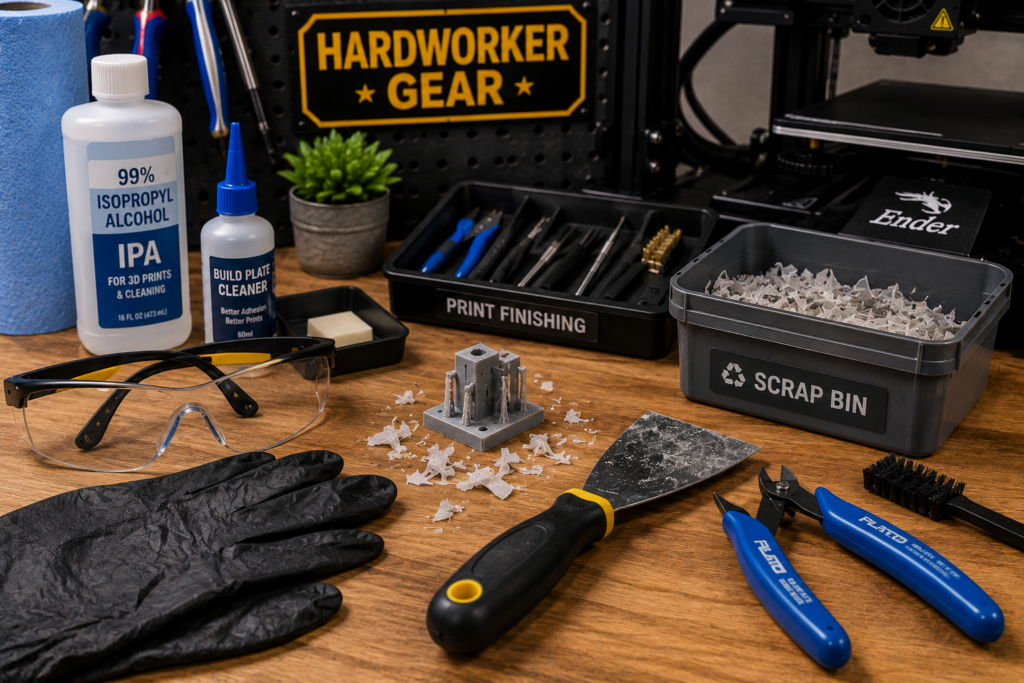
Starter Supply: Safety Glasses
Best for: Trimming supports, clipping filament, scraping prints, cutting plastic, and cleanup work.
Why it makes sense: Small plastic pieces can snap, fly, or break loose during cleanup. Eye protection is a simple habit worth building.
Safety glasses should be part of a beginner 3D printing setup.
That may sound like overkill if you are just printing small parts, but cleanup work can send tiny plastic pieces where you do not expect them. Flush cutters, scrapers, trimming tools, support removal, and brittle pieces can all create small hazards.
Eye protection is cheap, simple, and useful beyond 3D printing.
It also fits the HardWorkerGear rule: safety is not the place to save a few dollars.
12. Nitrile Gloves
Starter Supply: Nitrile Gloves
Best for: Adhesives, cleaning products, chemicals, resin-related work, dirty parts, and messy cleanup when skin protection is needed.
Why it makes sense: Gloves are not required for every basic FDM print, but they are useful when the material, cleaner, adhesive, or process calls for hand protection.
Nitrile gloves are not needed for every basic FDM print.
If you are printing PLA, removing a simple part, and trimming a clean edge, gloves may not matter much.
But gloves can be useful when working with adhesives, cleaning products, chemicals, resin printing, dirty parts, or materials where the manufacturer recommends skin protection.
For most beginners using a basic filament printer, gloves are more of a situational supply than a day-one must-have.
For resin printing, gloves and safety procedures matter much more. Most practical beginners should start with filament-based FDM printing before jumping into resin.
🦺 Safety First: Follow the printer, filament, resin, adhesive, and cleaning product instructions. Hot parts, sharp tools, fumes, dust, chemicals, and small plastic pieces all deserve basic safety habits.
13. Printer Station Storage
Starter Supply: Printer Station Storage
Best for: Keeping the printer, filament, tools, safety glasses, nozzles, finished prints, and scraps organized in one area.
Why it makes sense: A printer station keeps supplies controlled so the printer does not take over your desk, garage bench, or home workshop.
A beginner 3D printer needs a home.
Not just a spot for the machine, but a small system for everything that comes with it.
A good printer station should have room for:
- The printer
- Filament spools
- Tools
- Scraper
- Calipers
- Safety glasses
- Nozzle kit
- Small parts organizer
- Finished prints
- Failed prints and scraps
This does not have to be fancy. A sturdy desk, workbench, garage shelf, cabinet, cart, or dedicated corner can work if it is stable, clean, and safe.
Beginner 3D Printing Supplies Mentioned in This Guide:
- PLA Filament
- PETG Filament
- Basic 3D Printer Tool Kit
- Flush Cutters
- Scraper / Print Removal Tool
- Digital Calipers
- Filament Storage Box or Dry Box
- Nozzle Kit / Nozzle Cleaning Kit
- Bed Adhesion Supplies
- Small Parts Organizer
- Safety Glasses
- Nitrile Gloves
- Printer Station Storage
Start with the basics first. Add the later supplies only when your projects or printer problems call for them.
Supplies Beginners Can Wait On
Not everything belongs in your first cart.
Some supplies are useful later but unnecessary at the very beginning.
Specialty Filaments
Carbon fiber blends, flexible TPU, nylon, wood-filled filament, and other specialty materials can be interesting, but they are not where most beginners should start.
Learn PLA first. Add PETG second. Save specialty materials for later.
Major Printer Upgrades
Do not upgrade a printer before you understand it.
Beginners often add parts because they saw someone online recommend them. That can create more problems than it solves.
Large Nozzle Collections
A few spare nozzles can be useful. A huge nozzle collection is not necessary on day one.
Advanced Drying Equipment
Basic filament storage is usually enough to start. More advanced drying tools can come later if filament moisture becomes a real problem.
Resin Printing Supplies
If you are starting with an FDM filament printer, you do not need resin supplies. Resin printing is a different workflow with more chemical handling and cleanup.
Beginner 3D Printing Supply Mistakes to Avoid
Buying Too Much Filament Too Soon
Start with one or two reliable colors. Black, white, gray, or another practical color is usually enough to learn.
Skipping Measuring Tools
If you want to print useful parts, calipers are not optional for long.
Leaving Filament Out Everywhere
Filament should be stored, labeled, and kept clean. Do not let open rolls pile up around the printer.
Using Tools Carelessly
Flush cutters, scrapers, hobby knives, and files can all bite back. Slow down and pay attention during cleanup.
Buying Upgrades Before Learning the Printer
Use the printer first. Learn what bothers you. Upgrade only when you understand the problem.
Forgetting About Space
A printer, filament, tools, storage, and finished parts take more room than people expect.
💰 Worth the Money? The best beginner supplies are the ones that reduce frustration. Filament, calipers, a basic tool kit, storage, and safety gear are more useful than flashy upgrades you do not understand yet.
Best Starter Setup for a Student
A student setup should be simple, compact, and easy to store.
Start with:
- PLA filament
- Basic tool kit
- Digital calipers
- Small parts organizer
- Safety glasses
- Simple filament storage
Students should also think carefully about where the printer will live. Dorms, apartments, classrooms, labs, and shared spaces may have rules around machines, heat, noise, ventilation, power, or unattended equipment.
Best Starter Setup for a Garage or Home Workshop
A garage or home workshop setup can be a little more practical and storage-focused.
Start with:
- PLA filament
- PETG filament when ready
- Digital calipers
- Basic tool kit
- Filament storage box or dry box
- Small parts organizer
- Safety glasses
- Nozzle kit later
This setup supports tool holders, battery mounts, drawer dividers, garage labels, small trays, brackets, clips, and practical home workshop prints.
Best Starter Setup for a Desk or Home Office
A desk setup should stay clean and compact.
Start with:
- PLA filament
- Small tool kit
- Digital calipers
- Small parts organizer
- Filament storage bags
- Safety glasses
Desk users should avoid letting filament, tools, scraps, and test prints take over the whole workspace.
Final Beginner 3D Printing Supplies Checklist
Here is the simple checklist again:
- PLA filament — first material for most beginners
- PETG filament — useful later for tougher parts
- Basic 3D printer tool kit — print cleanup and maintenance
- Flush cutters — trimming filament and supports
- Scraper or print removal tool — removing prints safely
- Digital calipers — measuring parts that need to fit
- Filament storage box or dry box — protecting and organizing filament
- Nozzle kit — useful after you start printing regularly
- Bed adhesion supplies — only if your printer setup needs them
- Small parts organizer — keeping printer tools and parts under control
- Safety glasses — eye protection during cleanup work
- Nitrile gloves — useful for chemicals, adhesives, resin, or messy cleanup
Frequently Asked Questions
What supplies do I need for beginner 3D printing?
Most beginners should start with PLA filament, a basic 3D printer tool kit, digital calipers, filament storage, safety glasses, and a small parts organizer. PETG, nozzle kits, and bed adhesion supplies can come later.
What filament should beginners buy first?
Most beginners should buy PLA filament first. It is a good starting material for desk organizers, labels, trays, light-duty parts, school projects, and basic prints.
Do I need PETG filament as a beginner?
Not immediately. PETG can be useful later for tougher prints, garage parts, clips, and light-duty brackets, but most beginners should learn PLA first.
Do I need digital calipers for 3D printing?
If you want to print useful parts that fit real tools, drawers, brackets, holders, or storage spaces, digital calipers are one of the most useful tools you can buy.
Do I need a filament dry box?
You may not need an advanced dry box on day one, but filament storage matters. Airtight storage, desiccant, storage bags, or a simple dry box can help keep filament cleaner and more organized.
Are safety glasses really needed for 3D printing?
Safety glasses are a smart habit when trimming supports, clipping filament, scraping prints, cutting plastic, or cleaning up small parts. Tiny plastic pieces can snap or fly during cleanup.
Should beginners buy printer upgrades right away?
No. Learn the printer first. Buy upgrades only after you understand what problem you are trying to solve.
Do I need resin printing supplies?
Not if you are starting with a filament-based FDM printer. Resin printing uses a different workflow with liquid resin, curing, gloves, cleanup, and more chemical safety considerations.
Related Guides
Keep Building Your 3D Printing and Practical Smart Gear Setup:
- Is a 3D Printer Worth It for Students, Beginners, and Home Workshops?
- Best Beginner 3D Printers for Students, Garages, and Home Workshops
- Useful 3D Prints for Garages, Tool Organization, Dorms, and Desks
- Best Label Makers for Home, Garage & Back-to-School Organization
- Best Garage Storage Shelves for Home Workshops
- Best Garage Workbenches for Home Workshops
- Best Cordless Drills for Homeowners
Final Thoughts
Beginner 3D printing supplies do not have to be complicated.
Start with what helps you succeed: filament, measuring tools, cleanup tools, storage, and basic safety gear.
Do not buy every upgrade before you understand the printer. Do not collect every filament type before you learn PLA. Do not ignore storage until your workspace is covered in spools, tools, scraps, and nozzles.
The best beginner setup is practical.
For most people, that means PLA filament, a basic 3D printer tool kit, digital calipers, filament storage, safety glasses, and a small parts organizer. Add PETG, nozzle kits, bed adhesion supplies, and specialty tools when your projects actually call for them.
Used the right way, these supplies help turn a beginner 3D printer into a useful tool for students, garages, desks, home workshops, organization, and everyday problem solving.