
Useful 3D Prints for Garages, Tool Organization, Dorms, and Desks
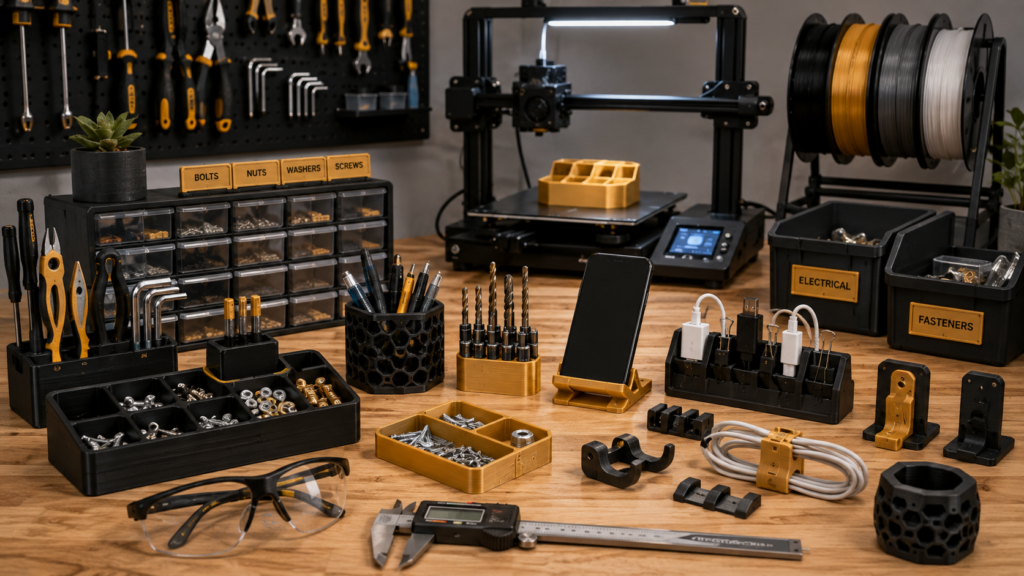
A 3D printer gets more interesting when it starts solving real problems.
Not every useful print has to be complicated. In fact, some of the best 3D prints for beginners are simple things: a cable clip, a drawer divider, a tool holder, a label tag, a small tray, or a hook that fits exactly where you need it.
That is where 3D printing starts to make sense for students, homeowners, garage users, and home workshop people.
You are not just printing random decorations. You are making small parts that help your space work better.
This guide focuses on useful 3D prints for garages, tool organization, dorm rooms, desks, home offices, storage bins, and practical everyday setups.
Disclosure: As an Amazon Associate, HardWorkerGear earns from qualifying purchases. This does not change the price you pay. This article is educational and idea-focused, but we may link to 3D printing supplies, filament, tools, storage, and related gear where it helps readers build a practical setup.
👉 Quick Tip: The most useful 3D prints are usually not the flashiest ones. They are the small parts that fix an annoying problem you deal with every week.
Why Useful 3D Prints Matter
A beginner 3D printer can be fun, but fun alone does not always justify the cost, time, or space.
Useful prints are different.
They help answer the real question: “What can I actually do with this thing?”
For HardWorkerGear readers, the best 3D prints usually fall into practical categories:
- Organizing tools
- Labeling storage bins
- Managing cords and chargers
- Dividing drawers
- Holding small parts
- Improving desks and dorm rooms
- Making garage storage more usable
- Creating small brackets, hooks, holders, and spacers
- Solving odd problems that store-bought organizers do not fit
That is the real strength of 3D printing. It lets you make small custom solutions for your exact space.
Before You Start Printing: Think Problem First
A lot of beginners start by asking, “What cool thing should I print?”
A better question is: “What annoying problem do I want to fix?”
That shift changes everything.
Instead of printing random objects that sit on a shelf, you start building a useful system around your workspace, tools, desk, garage, or dorm room.
Walk around your space and look for problems like:
- Loose cords
- Messy drawers
- Tools without a home
- Bins with no labels
- Chargers piled together
- Small parts mixed in one container
- Hooks that are almost right but not quite
- Desk items taking up too much room
- Garage shelves that need better organization
Those are the problems where 3D printing starts to become useful.
🤔 Something to Think About: A 3D printer is most valuable when it fills the gap between “I need a small custom part” and “I do not want to spend an hour searching for something close enough.”
Useful 3D Prints for Garage Organization
A garage is one of the best places to find useful 3D print ideas.
Garages collect tools, bins, fasteners, cords, chargers, seasonal gear, car supplies, cleaning tools, and half-finished projects. That creates a lot of small organization problems.
1. Storage Bin Label Holders
Storage bins are great until every bin looks the same.
3D printed label holders can help you mark bins for:
- Electrical parts
- Plumbing parts
- Fasteners
- Holiday storage
- Car care supplies
- 3D printer tools
- Safety gear
- Paint and finishing supplies
This works especially well if you already use garage storage shelves and plastic totes.
2. Wall Hooks
Wall hooks are one of the most practical beginner 3D prints.
You can use them for lightweight items like cords, safety glasses, small hand tools, tape rolls, dust masks, shop towels, and charging cables.
Do not use a printed hook for anything heavy or safety-critical unless the design, material, mounting method, and load are appropriate.
3. Pegboard Accessories
Pegboard is useful, but standard hooks do not fit every tool perfectly.
3D printed pegboard accessories can help with:
- Small screwdriver holders
- Hex key holders
- Bit holders
- Pliers holders
- Tape measure holders
- Nozzle and accessory trays
- Small parts cups
This is a good way to make a garage wall more custom without rebuilding the whole setup.
4. Battery Holders
If you use cordless tools, battery storage can get messy fast.
3D printed battery holders can keep batteries off the workbench and easier to find.
These can be useful for garage users who already have drills, impact drivers, work lights, tire inflators, or other cordless tools.
5. Cord and Hose Clips
Cords have a way of ending up in piles.
Printed cord clips can help organize extension cords, charger cords, USB cables, light-duty air hoses, and small power cords.
For anything carrying power, make sure the clip does not pinch, cut, overheat, or damage the cord.
⚠️ Common Mistake: Do not assume every printed part is strong enough just because it looks solid. Material, print orientation, infill, wall thickness, design, and mounting method all matter.
Useful 3D Prints for Tool Organization
Tool organization is one of the strongest practical uses for a 3D printer.
Most tools are shaped differently. That makes one-size-fits-all organizers frustrating.
3D printing helps because you can make holders that fit the tool, drawer, wall, or workbench you actually have.
6. Drill Bit Holders
Drill bits disappear easily.
A simple printed drill bit holder can keep common sizes organized and visible. This is especially useful near a workbench or cordless drill charging area.
7. Driver Bit Trays
Driver bits are small, easy to lose, and annoying to sort.
A printed bit tray can separate Phillips, Torx, square, hex, and nut driver bits so you do not waste time digging through a drawer.
8. Socket Organizers
Socket organizers can be printed to fit specific drawer sizes, socket sets, or labels.
This is a good beginner project because it teaches measurement. The holes need enough clearance to fit the sockets without being too loose.
9. Screwdriver Holders
A printed screwdriver rack can work on a pegboard, wall strip, drawer insert, or bench setup.
This is useful for basic hand tools, precision screwdrivers, hobby tools, and 3D printer maintenance tools.
10. Small Parts Trays
Every garage needs small parts trays.
Printed trays can hold screws, washers, nuts, nozzles, clips, spacers, drill bits, electrical connectors, and project hardware.
Small trays are also a good beginner print because they are useful even if they are not perfect.
11. Tool Drawer Dividers
Drawer dividers are one of the easiest ways to improve tool storage.
Instead of buying a generic organizer that almost fits, you can print dividers that match the drawer and tools you own.
12. Sandpaper and File Holders
Files, sandpaper, and finishing tools are easy to pile up.
A printed holder can keep them upright, visible, and separated by grit, size, or use.
🔍 Look For This: The best tool organization prints are the ones that save motion. If a printed holder keeps the right tool near the work area, it is doing its job.
Useful 3D Prints for Desks and Home Offices
A desk is another great place to find practical 3D print ideas.
Desk prints usually do not need heavy strength. They need to be neat, compact, and useful.
13. Cable Clips
Cable clips are one of the best first prints for beginners.
They help organize phone chargers, laptop cables, USB cords, monitor cables, keyboard wires, mouse cords, and desk lamp cords.
14. Phone Stands
A phone stand is simple, useful, and easy to customize.
You can print one for a desk, nightstand, dorm room, garage workbench, or charging station.
15. Headphone Hooks
Headphones take up more room than they should.
A printed hook can mount under a desk, on a shelf, or on the side of a storage unit.
16. Desk Drawer Dividers
Desk drawers fill up fast.
Printed dividers can separate pens, markers, sticky notes, flash drives, chargers, batteries, clips, small tools, and school supplies.
17. Pen and Marker Cups
Pen cups are easy to buy, but printing your own lets you match the exact size of your desk or drawer.
This is a good beginner project because it is simple and useful.
18. Laptop Stand Risers
Small risers can help create airflow and improve the angle of a laptop.
Use common sense here. Do not make a riser that is unstable, too narrow, or likely to slide.
19. SD Card and USB Holders
If you work with files, cameras, printers, school projects, or small electronics, SD cards and USB drives are easy to misplace.
A simple printed holder can keep them organized.
Useful 3D Prints for Dorm Rooms
Dorm rooms and small apartments need organization because space is limited.
The best dorm prints are compact, removable, and low-risk.
20. Charger Organizers
Students often have chargers for phones, laptops, tablets, earbuds, watches, and portable batteries.
Printed charger organizers can keep those cords from becoming a pile.
21. Backpack Tag Holders
A printed tag holder can help identify backpacks, gear bags, storage bins, laptop cases, or school supply containers.
22. Mini Shelf Dividers
Small shelf dividers can help separate notebooks, folders, school supplies, electronics, and desk items.
23. Command-Strip Style Light-Duty Holders
Some printed holders can be used with removable mounting strips for light-duty use.
These should only hold lightweight items. Do not trust removable strips or printed plastic with anything heavy, fragile, valuable, or safety-related.
24. Bedside Cable Guides
A small cable guide can keep a phone charger from falling behind the bed or desk.
This is one of those tiny prints that feels more useful than it looks.
25. Compact Desk Trays
Small trays can hold keys, earbuds, flash drives, change, ID cards, and daily carry items.
For students, small prints like this can help keep a cramped desk from turning into a junk pile.
Useful 3D Prints for Home Workshops
A home workshop sits somewhere between a garage and a desk.
You may have tools, parts, supplies, measuring gear, project hardware, labels, and repair items all in the same space.
26. Digital Caliper Holder
If you are making practical prints, digital calipers become one of your most important tools.
A printed holder keeps them protected and easy to find.
27. Filament Clip and Spool Labels
Filament clips keep loose filament ends from tangling.
Spool labels can help you track material type, color, and remaining amount.
28. Nozzle Storage Case
3D printer nozzles are small and easy to lose.
A printed storage case or labeled tray can keep nozzle sizes organized.
29. Scraper and Tool Holder
Scrapers, flush cutters, files, brushes, and removal tools need a home.
A printed tool holder near the printer helps keep the setup cleaner.
30. Test Fit Blocks
Test blocks help you check hole sizes, tolerances, slots, and fit before printing a larger part.
This is a smart habit for anyone printing practical parts that need to fit something else.
31. Project Bins and Labels
Small project bins can help separate active prints, failed prints, spare parts, hardware, and repair pieces.
Adding printed labels makes the system easier to keep organized.
💰 Worth the Money? 3D printing gets more valuable when it supports the tools you already own. Printed holders, trays, labels, and organizers help your garage, desk, and workshop work better without turning every fix into a shopping trip.
What Material Should You Use for Useful Prints?
Material choice matters.
For most beginners, PLA filament is the easiest place to start. It works well for many desk organizers, labels, trays, light-duty holders, and beginner projects.
For parts that need more heat resistance or toughness, PETG filament may be a better choice once you understand the basics.
That does not mean PETG is automatically better for everything. PLA is easier for many beginners, and PETG may require more tuning.
A simple way to think about it:
| Material | Best For | Watch Out For |
|---|---|---|
| PLA | Desk organizers, trays, labels, simple holders, school projects, beginner prints | Not ideal for high heat, heavy loads, or demanding outdoor use |
| PETG | Tougher garage parts, light-duty outdoor use, clips, brackets, parts needing more durability | May need more tuning than PLA |
Useful Prints Beginners Should Avoid at First
Not every useful-looking print is a good beginner project.
Start with low-risk organization prints before moving into anything that needs strength, heat resistance, or safety margin.
Beginners should be careful with:
- Load-bearing brackets
- Heavy-duty wall mounts
- Car parts exposed to heat or stress
- Parts used around electricity
- Parts used near moving machinery
- Anything safety-critical
- Anything that could fail and damage expensive gear
🦺 Safety First: Useful does not always mean safe for every job. Printed parts can fail. Do not use beginner prints for critical support, high heat, electrical protection, vehicle safety, or anything where failure could hurt someone or damage equipment.
Beginner Tips for More Useful Prints
Measure First
If a part needs to fit, measure the space. Digital calipers are one of the best tools a practical 3D printer user can own.
Print a Small Test Piece
Before printing a big holder or bracket, print a small section to test fit.
Start with Simple Shapes
Simple trays, clips, holders, and dividers are better beginner projects than complicated moving parts.
Label Everything
Printed labels and tag holders make storage systems easier to maintain.
Organize Your Printing Supplies
Filament, nozzles, tools, scrapers, cutters, spare parts, and failed prints can create clutter fast. Use storage bins or a small parts organizer from the beginning.
Do Not Chase Perfect
A useful print does not need to be perfect. It needs to solve the problem.
Best Starter Supplies for Useful 3D Prints
You do not need a massive accessory pile to start making useful prints.
For practical garage, dorm, desk, and workshop projects, these are the supplies that make the most sense early:
| Starter Supply | Why It Helps | Best Use |
|---|---|---|
| PLA Filament | Easy starting material for many beginner prints. | Desk organizers, labels, trays, school projects |
| PETG Filament | Useful later for tougher parts after you learn the basics. | Garage parts, clips, light-duty brackets |
| Digital Calipers | Helps prints fit the real object or space. | Tool holders, drawer dividers, socket trays |
| Basic 3D Printer Tool Kit | Helps remove, trim, clean, and finish prints. | Everyday printing setup |
| Filament Storage | Keeps filament dry and organized. | Long-term filament care |
| Small Parts Organizer | Keeps nozzles, bits, fasteners, and printer tools together. | Printer station and garage setup |
| Safety Glasses | Useful when trimming, clipping, scraping, or working around small plastic pieces. | Print cleanup and workshop safety |
Useful 3D Printing Supplies Mentioned in This Guide:
- PLA Filament
- PETG Filament
- Digital Calipers
- Basic 3D Printer Tool Kit
- Filament Storage
- Small Parts Organizer
- Safety Glasses
These are support links for practical printing, not a full supplies checklist. The full beginner supplies checklist is the next article in the series.
How to Build a Useful Print List
The best way to get value from a 3D printer is to keep a running print list.
Every time you notice a small problem, write it down.
Use categories like:
- Garage
- Tools
- Desk
- Dorm
- Storage bins
- Cords and chargers
- Printer supplies
- Home workshop
- School projects
Then start with the easiest, lowest-risk prints.
A good first week of useful printing might look like this:
- Day 1: Cable clip
- Day 2: Desk tray
- Day 3: Label holder
- Day 4: Small parts tray
- Day 5: Tool holder
- Day 6: Filament clip
- Day 7: Drawer divider
That kind of simple progress builds skill and keeps the printer useful.
Frequently Asked Questions
What are the most useful 3D prints for beginners?
The most useful beginner prints are usually cable clips, drawer dividers, tool holders, label holders, small parts trays, phone stands, desk organizers, and storage bin labels.
What are useful 3D prints for a garage?
Useful garage prints include tool holders, battery holders, pegboard accessories, drill bit holders, socket organizers, small parts trays, cord clips, wall hooks, and storage bin labels.
What are useful 3D prints for a dorm room?
Useful dorm prints include charger organizers, cable guides, small trays, desk organizers, shelf dividers, backpack tag holders, and light-duty removable holders.
What are useful 3D prints for a desk?
Useful desk prints include cable clips, phone stands, headphone hooks, pen cups, drawer dividers, laptop risers, SD card holders, USB holders, and small storage trays.
Should beginners print with PLA or PETG?
Most beginners should start with PLA because it is easier for basic projects. PETG can be useful later for tougher parts, garage pieces, clips, and light-duty brackets.
Can 3D printed parts be used for tools?
Yes, 3D printed parts can be useful for tool organization, bit holders, trays, labels, and light-duty holders. Be careful with anything load-bearing, heat-exposed, electrical, or safety-critical.
Do I need to design my own 3D prints?
No. Beginners can start with existing designs, then learn to modify or design simple parts later. Over time, designing your own parts makes the printer much more useful.
What should I avoid printing as a beginner?
Avoid safety-critical parts, heavy load-bearing mounts, parts exposed to high heat, electrical protection pieces, vehicle safety parts, and anything where failure could cause injury or damage.
Related Guides
Keep Building Your 3D Printing and Practical Smart Gear Setup:
- Is a 3D Printer Worth It for Students, Beginners, and Home Workshops?
- Best Beginner 3D Printers for Students, Garages, and Home Workshops
- Beginner 3D Printing Supplies Checklist: Filament, Tools, Storage, and Safety — Coming Soon
- Best Label Makers for Home, Garage & Back-to-School Organization
- Best Garage Storage Shelves for Home Workshops
- Best Garage Workbenches for Home Workshops
- Best Cordless Drills for Homeowners
Final Thoughts
Useful 3D prints are where a beginner printer starts to prove itself.
A cable clip may not look exciting. A label holder may not impress anyone. A small tray may not seem like much.
But when those prints make your garage cleaner, your desk easier to use, your dorm room less cluttered, or your tool setup faster to work from, they matter.
That is the practical side of 3D printing.
Start with small problems. Print simple solutions. Measure carefully. Use the right material. Avoid safety-critical parts until you know what you are doing.
Used that way, a 3D printer becomes more than a gadget. It becomes a small problem-solving tool for your garage, desk, dorm room, and home workshop.